CLICK ON THE LINKS BELOW FOR MORE HARPENDEN NEWS
Active News for Harpenden 2026
Sustainability and Climate Crisis Strategy for St Albans District and Harpenden is launched.
A new sustainability and climate crisis strategy for St Albans District and Harpenden with the aim of achieving net zero by 2030 has been launched.
The strategy covers the years from now until 2027 and sets out measures to cut harmful emissions and improve the local environment.
St Albans City and District Council declared a climate emergency in 2019 and produced a strategy with more than 100 actions for 2020 to 2023.
Last year, Councillors also declared a sustainability and biodiversity emergency, recognising the urgent need to protect and enhance nature.
Now the Planning Policy and Climate Committee has approved an updated strategy to progress all this vital work.
The strategy includes further initiatives to improve the sustainability of the Council’s own operations and services with its emissions having been cut by 52% since 2009.
It also sets out commitments and proposals to:
*Boost the energy efficiency of new and existing buildings around the District.
*Promote active and sustainable transport to improve air quality.
*Reduce waste, encourage recycling and campaign for sustainable food production.
*Enhance the natural environment and allow biodiversity to flourish.
Conserve precious water resources and ease flooding risks.
Councillor Raj Visram, Lead for Climate, said: “Since declaring a climate emergency, we have made great strides forward and taken many positive actions.
“For example, we have planted many thousands of trees and spent more than £20 million on improving the energy efficiency of our social housing properties with more work scheduled.
“Our parking services team now has an all-electric vehicle fleet and 18 more electric vehicle charging points have been installed around the District.
“We have also helped to set up the St Albans Home Energy Support Service which provides free advice to households on making their homes more energy efficient and how to obtain funding.
“However, we are not complacent and this updated strategy will further boost our efforts to tackle the climate emergency and create a carbon neutral District.
“It highlights the areas where we will be making major efforts in the years ahead to promote sustainability and I am sure we will have the support of our residents and businesses as we continue with this priority project.
“I would urge all those who are passionate about their local environment and the need to make improvements to take the time to read this strategy. We need everyone to buy into what we are doing.”
Among the new measures the strategy commits the Council to is a campaign to increase opportunities for the community to become involved in its climate work.
St Albans Greener Together will be launched soon with the aim of helping residents, schools, community groups and businesses find solutions to environmental issues.

SEPT 23 2024 HTC COUNCIL MEETING MINUTES
23.1 SADC PARKING PROPOSALS – Council considered a
report by the Town Clerk & Chief Executive. Council
RESOLVED to:Agree the following statement relating to the HTC view on what has happened so far regarding the parking proposals:
• The Town Council has been very concerned with the
proposals set out in the consultation and objects to them.
• The Town Council does not support any charges for on-street
parking in Harpenden Town Centre.
• SADC appears to be adopting a ‘one size fits all approach’ which
for example, does not reflect the key differences between St Albans City Centre and Harpenden Town Centre.
• SADC’s communications on this matter have been poor and
have created areas of concern and perceptions that could have
been avoided.
• It is questionable as to whether an appropriate consultation process has been carried out given the communications put out and timeline inconsistencies.
• Earlier engagement with the local community and Town Council
around the time of budget setting, in the form of a non statutory
consultation, would have helped SADC to understand the local
parking issues and enabled the development of a set of
proposals that could make improvements locally without the
potential for significant local damage.
• A more positive response to the Town Council offer of a formal joint collaboration in parallel to the consultation would have increased the chances of producing better proposals.
Agree the following statement as to what should happen next:
• HTC calls on SADC to carefully consider the consultation
responses and listen to the views of the community.
• We recognise that improvements need to be made to parking
policy locally, however SADC should develop an alternative
approach that sees major changes to what was proposed
during the consultation.
• HTC will carefully consider any changes proposed by SADC
and will consider its view on them at the appropriate time. If no
changes are put forward or if minor changes are suggested
that do not significantly address the consultation themes, then HTC
will consider instructing an initial legal view on the validity of
the process that has been carried out. This initial view may
lead to HTC initiating more formal legal action.
• More widely, HTC requests that SADC learn from this experience
and engage with us much earlier when developing any proposals
that have such an impact on the Town.
• HTC stands by its previous Resolution made at the
Extraordinary Council Meeting on 22 July to offer to work in
formal joint collaboration with SADC to develop alternative
proposals. Agree its support to the following alternative on street
parking proposal:
• Allow 1hr free parking, with no return within 1 hour, and no
option to remain longer than 1hr.
• Improved bay infrastructure i.e. markings, signage.
•• More effective enforcement.
•• Consistent maximum stays on all bays including Disabled Bays.
•• Minimal additional Loading Bays where there is a clear need and
they have limited impact on general parking bays.
• Introduction of more flexible permit options by SADC that
support retail workers and workers from the voluntary sector.
• Introduction of appropriate and accessible communications
channels setting out the various options for parking in
HarpendenTown Centre. END
Feb 3. 2025
Statement from Jeff Phillips. Chair, The Harpenden Society.
“The Harpenden Society is disappointed by the insistence of SADC to impose parking charges in the centre of the town starting Feb 17th. This despite substantial local opposition and suggestions from the town council and ourselves that would have facilitated sensible compromises.
“Pushing through this charging regime, which has barely altered from the regime proposed prior to the consultation period is, frankly, insulting.
“The Society accepts the principle of charging, but as an example, the single visit 30 minute free period per day could mean parents at the two town centre schools to have to pay for parking when they pick up their children at the end of the school day. This assumes they have used the free 30 minutes on another visit during the day.
“And to add insult to injury, SADC have agreed to delay the implementation of charges in the roads around Clarence Park in St Albans ‘until a wider review’ has taken place.
“Both the town council and the Society have argued strongly for such a review of the wider parking issues to take place in Harpenden as well.
“There seems to be one law for St Albans residents and another for the residents of Harpenden. We repeat our request for these proposals to be suspended so that a fair and sensible parking strategy and charging regime can be developed for the town centre.”

JAN, Shaping the future of local government in Hertfordshire.
Currently, Hertfordshire has a county council, which looks after things such as children and adult social care, roads and education, and a further 10 district and borough councils, which provide services such as social housing, planning and waste collection. There are also a number of parish/town councils, such as Harpenden, with limited powers devolved from the district councils.
The Government believes having a smaller number of all-purpose councils would make local government simpler, more accountable and more sustainable.
So, say goodbye to these Councils: Herts CC. St Albans, Broxbourne, Dacorum, Hertsmere, North Hertfordshire, Stevenage, Welwyn, Hatfield, East Hertfordshire, Three Rivers, and Watford.
And say hello to: a number of Unitary Authorities for the county – likely made up of two, three or four separate units
Existing Town Councils and Parish Councils are probably going to see increased powers devolved to them, and new councils created at this level to cover non-parished areas of the county, such as St Albans City itself.
Who makes the final decision? The Government. They believe that having a smaller number of all-purpose councils would make local government simpler, more accountable, more cost effective and more sustainable. They actually consulted in late Autumn and asked all 11 existing councils in Hertfordshire whether they thought the county should split into two, three or four unitary authority areas in the future.
The Harpenden Society view:
In our opinion, if the costs before and after are evenly balanced, or, at least, cost benefits not conclusively made out, then undoubtedly the more favourable cost case would come with two unitaries, not three or four.
A reorganisation to simply merge St Albans and Dacorum, adding in current county council powers, would not seem to be worth the disruption and cost.
The Harpenden Society committee notes that the government is determined to reorganise local government by creating unitary authorities. We hope that it does indeed make for greater efficiency, reducing bureaucracy and overlap.
The Government have also decided that there will be further devolution of central government powers (yet to be determined) to a strategic authority and this is to be welcomed, provide fragmentation does not go too far in creating inefficiencies.
The two-unitary proposal for Hertfordshire will, in our opinion, likely give the best opportunity to balance the need for local input with operational efficiency.
We would particularly welcome devolution of super-local assets and services to Harpenden Town Council, which benefits from immense local respect, provided the financial consequences are not detrimental to residents.
Timetable: Full proposals from the 11 Councils were submitted to Government - 28 Nov 2025; Government statutory consultation - Feb–Mar 2026; Government decision on model (2, 3 or 4 unitaries) - Summer 2026; Shadow authority elections - May 2027; County Council. Vesting Day (unities take full powers) - 1 Apr 2028.
Other Views
Steve Jarvis, leader of Hertfordshire County Council, said: "We think the two-unitary option is the one that is best placed to deliver services to people at the lowest cost, which will mean we have the most money available for delivering services.”
St Albans District Council also takes the same view.
Jeff Phillips (Chair the Harpenden Society) said ‘Many residents are unaware that this process of change is already underway and may not have read the background rationale, and we are still awaiting any guidance on the future role and responsibilities of town and parish councils, specifically our own Harpenden Town Council.
As for the financial impact of these changes, the devil will inevitable be in the detail. But we have set up a page on our web site with more info and this will be updated as more information becomes available.

Feb 27. District Councillors approve a budget in the face of a challenging financial climate and a 2.99% rise in the District’s Council Tax
St Albans City and District Councillors have agreed a “sound and fair” budget for the next financial year along with a long-term plan setting out their priorities for action.
The Council (SADC) is required to produce a balanced budget every year, ensuring spending is matched by the income it raises from various sources.
In common with other local authorities, it has been faced in recent years with a challenging economic climate that has put intense pressure on its finances.
This includes rising costs and a much higher demand for homelessness support.
As part of the 2026/27 budget, Councillors agreed to a 2.99% rise in the District’s Council Tax bill. This supports a gross Council spend of £58.8 million, excluding social housing spend and income.
This means a resident in a Band D property will pay an average of £214.22 to the Council for its services in the coming year – an increase of just 12p a week.
SADC’s portion of Council Tax amounts to around 9% of the total collected, with Hertfordshire County Council receiving 77%, the Police,11%, and the parish and town councils, who set their own budgets, 3%.
The money received by SADC will fund key services including waste and recycling collections, street cleaning, leisure and cultural services, planning, parks and open spaces, 24/7 CCTV protection, environmental health and grants to voluntary bodies such as Citizens Advice.
Councillors also approved a rent rise in accordance with Government guidelines of 4.8% for its social housing properties. Garage rents will increase by 6.7%
The budget was approved at a meeting of the Full Council on Wednesday 25 February.
Councillor Giles Fry, Lead for Resources, said after the meeting: “I am pleased that Full Council has agreed to a balanced budget that is both fair and financially sound.
“It will protect our key services, such as our leisure, community and cultural facilities, while also allowing for some notable investments such as a new community and sports hub in the New Greens area.
“Over the last year, commercial tenants have begun to move into Jubilee Square which will provide us with much-needed new income in the future. We will continue to look for other revenue-raising opportunities.
“I hope our residents will continue to support the work we are doing to further strengthen our communities in the face of a tough financial climate.”
Full Council also approved a Council Plan for the next two years which is founded on four priorities. These are to:
Support great communities
Provide more social housing.
Make the environment a priority in all Council decisions.
Treat everyone with fairness.
The Plan includes the many actions the Council is committed to taking to achieve these goals.
Councillor Paul de Kort, the Council Leader, said after the meeting: “One of the dominant issues for next year is the Government’s plan to restructure local government.
“This will see the abolition of the two-tier system of district and county councils and its replacement by new unitary authorities.
“As we move towards this new structure over the next couple of years, we must not lose sight of our priorities such as providing theDistrict with more social housing, improving the local environment and keeping our District a great place to live and work.”
Details of the budget together with the Council Plan can be viewed along with the Full Council meeting papers here.



Exciting Conservation Project
in Harpenden –Reintroduction
of Water Voles
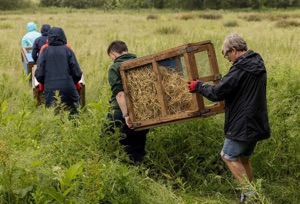
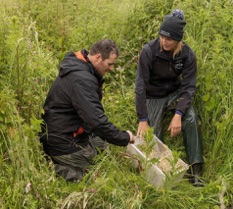
Harpenden Town Council has released
200 water voles in the Upper River Lea,
a project which has taken rigorous
planning over the last three years and
reintroduces this important species to
Batford Springs Local Nature Reserve
after 40 years.
Water Voles are incredible ecosystem engineers bringing huge benefits to waterways and a wide array of flora and fauna. They manage rivers and streams by foraging and burrowing to increase biodiversity. They eat coarse dominant grasses like sedges and rush, opening gaps for more delicate waterway plants to establish. With greater floristic diversity, more bees, butterflies and pollinators will return to the river, and insects, birds, bats and mammals will follow. When a water vole abandons one of their burrows, new critters will move in to raise their young, like shrews, which in turn improve the health of the nearby habitats.
Water voles were once common in England’s rivers and streams including at Batford Springs. Sadly, they have been in decline for over 40 due to habitat loss and the invasive mink.
Harpenden Town Council, together with dedicated volunteers at Batford Springs, released the Water Voles following a carefully managed process last week.
Cllr Kirsti Wenn, Mayor of Harpenden said, “It is fantastic to be part of this important step in the reintroduction of water voles, another incredible addition to Batford Springs Local Nature Reserve. It has been a real pleasure to watch this conservation project, from its infancy to the release of our new residents, and I can’t wait to see how the water voles will help the Town Council continue to improve the environment and local ecosystem. Batford Springs Local Nature Reserve is not only a beautiful green space, but it is the home of hugely important habitats and we are immensely proud of all we have achieved here.”

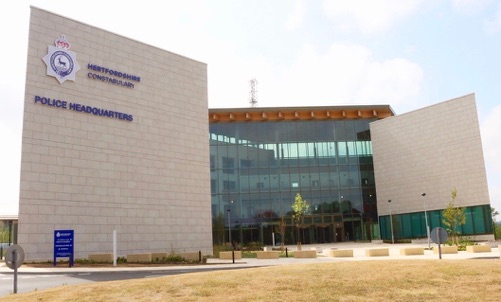
Sept 15. New Hertfordshire Police Headquarters building officially opened on Sept 8th
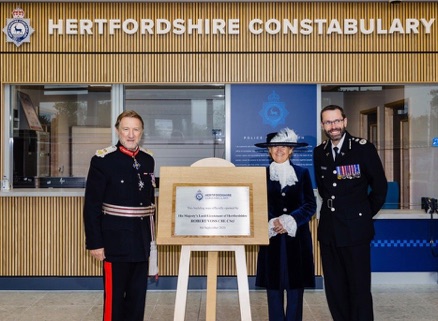
The new building at Hertfordshire Constabulary Headquarters was officially opened this week by the Lord-Lieutenant of Hertfordshire, Robert Voss CBE CStJ.
The building, which will house around 1,000 officers and staff across a number of departments, as well as the Office of the Police and Crime Commissioner for Hertfordshire, has wellbeing, efficiency and collaborative working at the forefront of its design.
During the opening which took place on Tuesday 8 September, the Lord-Lieutenant unveiled a plaque and toured the building. Alongside local dignitaries he also met those involved in the building project as well as officers and staff working at the new site.
Upon opening the building, the Lord-Lieutenant read a message from His Majesty King Charles III. The message congratulated the positive socio impact the building will have on the local community and included his warm regards to those attending the event.
Chief Constable Andy Prophet said: “The opening of the new Hertfordshire Constabulary HQ building is an important moment for the Force. It was an honour to welcome the Lord-Lieutenant to open our HQ and a lovely surprise to hear the message from His Majesty, King Charles III.
“Our former HQ served us well for 50 years but was becoming inefficient and the costs of running, maintaining and repairing it were making it uneconomical.
"The new building will serve us for the next 50 years. It will enable my officers, staff and volunteers to be at their very best. To work collaboratively, in modern, open plan working spaces, to learn from one another and to drive innovation. By creating an environment where people can thrive, this building will play an important role in helping us prevent crime and harm, solve crime and catch criminals and protect the vulnerable."
It is the only police force building nationally that has been awarded a platinum ‘WELL’ accreditation – the highest possible standard for health and wellbeing in the built environment.
The building has been awarded ‘excellent’ BREEAM status - demonstrating national best practice in areas like energy efficiency, water conservation and wellbeing.
Police and Crime Commissioner for Hertfordshire, Jonathan Ash-Edwards, said: “Hertfordshire Constabulary’s new HQ has been delivered on time and through strict governance procedures and closely working with Willmott Dixon and their supply chain the project was delivered under the approved project budget, which is an important result for local taxpayers. It provides a modern, fit for purpose base for operational policing, such as major crime and public protection units, and crucial support functions. This new HQ helps to future proof policing in Hertfordshire, giving our police officers and staff a modern base from which to keep Hertfordshire safe for many years to come”
Building Background
Demolition of the previous building began in February 2024, and both the demolition and construction phase was managed by Hertfordshire based developer, Willmott Dixon.
Willmott Dixon has delivered a social and economic impact worth more than £28 million to the Hertfordshire community through its construction. The social return on investment has been achieved through the company’s comprehensive community engagement programme, creating lasting opportunities for local residents.
The building was officially handed over to the Constabulary in mid-July and officers and staff have been working in the building since the beginning of August.

Fines to be increased in crackdown against
fly-tipping
Fixed Penalty Notice fines for fly-tipping offences in St Albans District are to be substantially increased to deter offenders.
Maximum fines for fly-tippers will rise from £1,000 to £3,000 for the most serious crimes.
For duty of care offences – a failure to ensure rubbish is disposed of by a registered waste carrier – the maximum fine will rise from £600 to £1,000.
The changes were agreed by the Public Realm Committee of St Albans City and District Council at its meeting on Thursday 10 September.
New Government regulations for waste-related offences have allowed local authorities to increase the fines.
Since April this year, the Council's Environmental Enforcement team has issued 23 FPN fines with 24 issued during the previous year.
The Council operates a sliding scale of fines with only the worst offences being issued with the maximum penalty.
Decisions on the amount to issue depend on the size of the tip, the environmental harm and the clearance costs.
Prosecutions in the courts are launched against some of the most serious or persistent offenders or those who fail to pay their fines.
During 2025/26, the Council secured six successful prosecutions and since April have secured another prosecution with 13 cases pending.
Councillor Edgar Hill, the Committee's Vice-Chair and Lead for Fly-Tipping, said: "The increase in fines shows our determination to crack down on the scourge of fly-tipping both in our urban and rural areas.
"Fly-tips are not only a criminal offence, but they are also an eyesore, a potential health hazard and can be very costly to clear up. There is no excuse for not disposing of waste safely and in accordance with the law.
"We are in the top three district councils in Hertfordshire for issuing Fixed Penalty Notices and prosecutions. We will continue to build on this excellent enforcement performance by investigating tips, gathering evidence, tracing offenders and taking appropriate action.
"We know as Councillors that our residents get very angry about fly-tips which are a blight on their neighbourhoods, so I am sure they will support this initiative."
Photo: a recent fly-tip in Harpenden which led to a successful prosecution.


Aug 21 Harpenden children choose new Hopper community bus name: “Hetty Hopper”
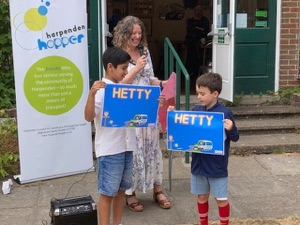
Harpenden Hopper, community bus service, together with Harpenden Town Council asked local children to name their new bus. Children were invited to submit names for the bus together with a creative design for a Hopper poster in a competition this Summer. Congratulations to Aryan, Luke, James and Rory who all suggested the winning name 'Hetty' for the new bus which the judges agreed makes a great working partner for Harold the Hopper bus
.
New bus “Hetty Hopper” was purchased by Harpenden Town Council and will join Harold as part of the Hopper service from this Summer.
Current Harpenden Hopper minibuses named "Harold” and “Holly” have serviced the Harpenden Community since 2018. With Holly’s retirement this year, Harpenden Town Council purchased the new vehicle in August to continue supporting and partnering this formidable charity. Hetty will be seen in full service later this summer


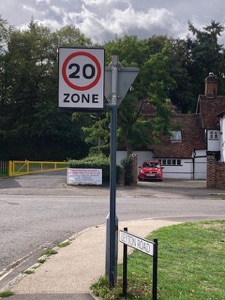
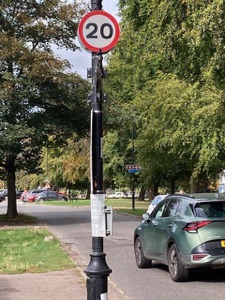
Sept 22, Would you like to see more 20mph zones in Harpenden?
Herts County Council are proposing the introduction of new 20mph areas in residential streets, town centres and around schools to improve road safety, create calmer streets and encourage more walking and cycling.We are asking residents, businesses, schools and local communities to help shape how a future 20mph scheme could look by telling us whether, and where, they believe lower speed limits are most appropriate. We also recognise that views differ on where 20mph limits should be used and that not every road will be suitable.
In particular, we would welcome your views on whether other key streets, including Southdown Road, Grove Road, Piggottshill Road, Station Road, High Street and Lower Luton Road, as well as the lanes crossing Harpenden Common, should be subject to a 20mph limit.
By completing this survey, your feedback will help us understand local priorities and inform the potential development of 20mph areas within Harpenden
.
Please ensure responses are submitted by 23:59 on Sunday 11th October 2026
Sept 7. Local government reorganisation in Hertfordshire paused
The Government decided to create four unitary councils in Hertfordshire, but this will now be reviewed.
Local government reorganisation in Hertfordshire has been paused as the Government launches a review of the plans following new legal advice.
The Ministry of Housing, Communities and Local Government (MHCLG) said the review is to ensure the process is robust and aligns with the new Government's aim to "rewire the state", and follows "updated and privileged legal advice".
At least eight councils have launched legal challenges or were considering to do so due to opposition to the Government’s choice of footprints for new councils.
Decisions on 14 areas will be reviewed and paused, with Hertfordshire among those.
Hertfordshire County Council confirmed last week it had formally asked the Government to disclose all the evidence for their decision to create four unitary councils in the county.
"This is a step we have taken reluctantly," said council leader Steve Jarvis